
12 Sep 2026 · Articles
Economic Snapshot: August 2026
Markets continue to adapt to changing economic conditions, creating both challenges and opportunities for investors. Our August 2026 Investment and Economic Outlook explores the forces shaping the investment landscape and what they could mean for your portfolio.
Read now
In summary
August was broadly positive for equity markets, with resilient corporate earnings and renewed enthusiasm for Artificial Intelligence (AI) supporting global equities. Sentiment softened late in the month as escalating US-Iran tensions pushed energy prices higher and expectations for tighter monetary policy increased.
Australian equities also advanced, led by the materials sector as stronger commodity prices supported mining earnings, while small caps materially outperformed. Globally, US technology sector remained a key source of strength, with AI and software earnings reinforcing confidence in the investment theme.
Australian inflation surprised to the upside, strengthening expectations for further hikes in the cash rate by the Reserve Bank of Australia (RBA). In the US, hawkish commentary from the US Federal Reserve (Fed) Chair, Kevin Warsh increased expectations of a rate rise in September.
Selected market returns (%)
AUGUST 2026
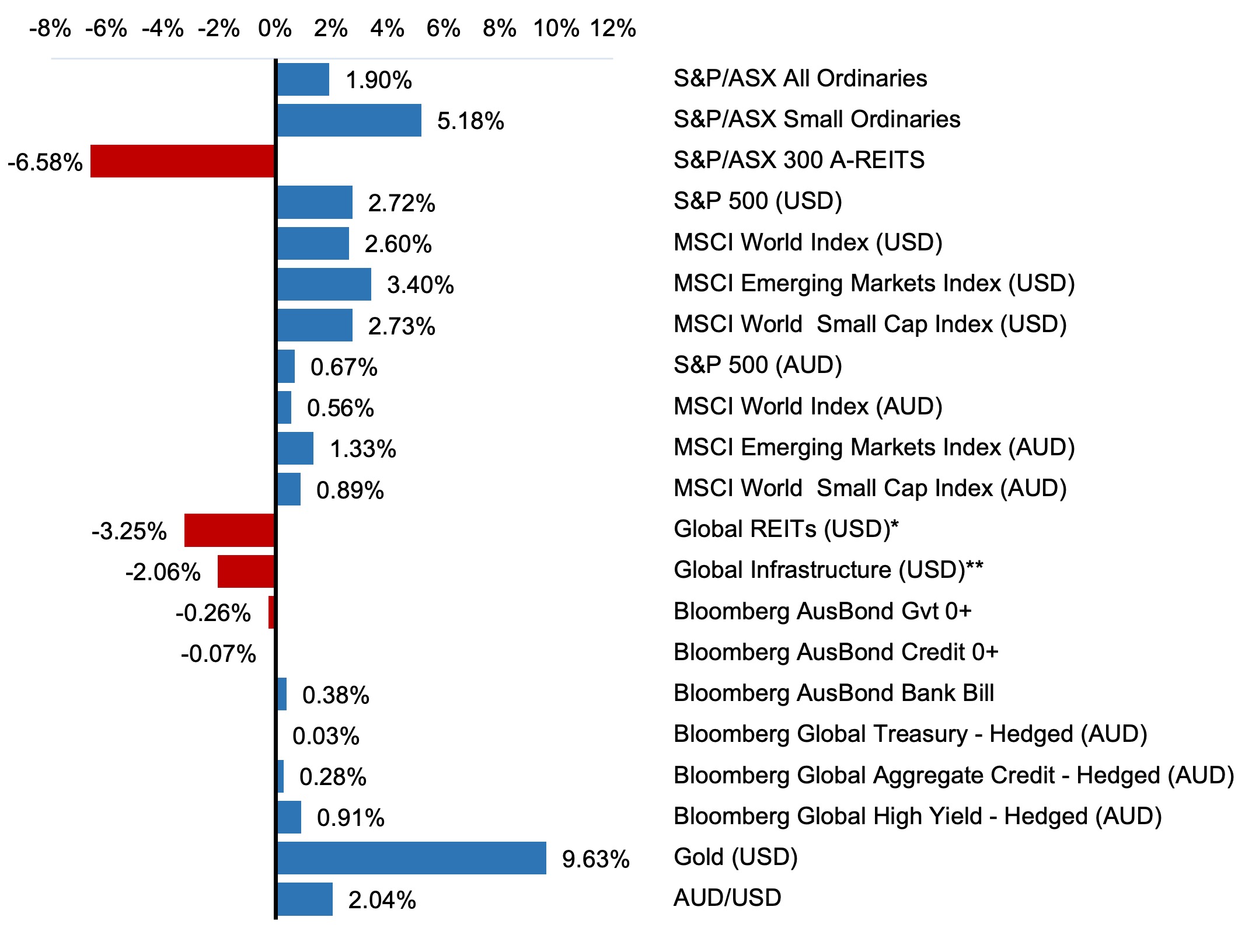
Sources: *FTSE EPRA/NAREIT DEVELOPED, **FTSE Global Core Infrastructure 50/50 Index
Financial markets
The sentiment in August was broadly ‘risk-on’, supported by resilient earnings, stronger commodities and renewed enthusiasm for AI. Tensions emerged later in the month as expectations of rate rises increased, challenging the strong structural growth themes, with higher bond yields, rising oil prices and geopolitical risk tempering sentiment.
Australian equities
August was a positive month for Australian equities, with the All Ordinaries gaining 1.9%. The reporting season pointed to a return to earnings growth, with financial year 2026 corporate profits rising 11.6% following three years of contraction. However, the recovery remained relatively narrow, with earnings growth of just 5.3% when excluding mining and energy, while only 36% of companies exceeded expectations.
The materials sector led the market, rising 12.0%, supported by stronger commodity prices and improving earnings across the resources sector. Gold was strong, while elevated metals prices supported major miners. Healthcare was another standout, driven by sharp recoveries in CSL and Cochlear following stronger-than-expected earnings.
Australian small caps materially outperformed, with the Small Ordinaries gaining 5.2%. The reporting season was generally better than anticipated, while strength across resources, infrastructure investment, healthcare and technology supported the broader recovery in smaller companies.
Global equities
Global equities advanced in August, with the MSCI World Index returning 2.6% in USD. Gains reflected resilient corporate earnings and renewed appetite for growth assets following weakness in July.
US equities led developed markets, with the S&P 500 gaining 2.7%. The Nasdaq 100 rose 3.7% as technology reasserted itself following a softer July. Strong earnings across AI and software names reinforced confidence in the AI investment theme, although gains moderated later in the month as expectations for higher interest rates weighed on sentiment.
European equities were weak, with the EURO 100 falling -0.4%. Japanese equities strengthened, rising 3.1%, as a weaker yen supported exporters.
Emerging market equities returned 3.4% in USD, supported by renewed enthusiasm for Asian technology and AI-related beneficiaries.
Commodities
Oil markets were volatile in August, driven by further escalation of hostilities between the US and Iran. Crude oil traded between
$74 – $89, ending the month at $86. Gold found increased strength off the back of weak US jobs data and softer inflation, rising from lows of $4000 to over $4700 before closing the month at $4442.
Bond markets
Bond markets remained under pressure in August, weighed down by sticky inflation and hawkish central-bank commentary. The Australian 10-year yield pushed above 5% for the first time since May on a higher-than-expected inflation print, closing the month at 5.08%. The RBA held the cash rate steady at 4.35%, with markets pricing in one rise before year-end.
The US 30-year yield rose above 5.3% mid-month to reach levels not seen since 2007. The 10-year bond traded sideways for most of the month, between 4.6% and 4.7%. Hawkish comments from Fed Chair, Kevin Warsh led markets to raise the probability of a September rate hike, which saw the 10-year bond yield rise to 4.75% at month end.
Economic developments
Inflation eases at the margin, but stays above target
Inflation remained sticky in both Australia and the US, with differing drivers that ultimately resulted in a bond market sell-off. The Australian Headline Consumer Price Index (CPI) for July rose 3.5% year-on-year, down from June’s 3.8% but above the 3.3% consensus estimate. Housing costs were the major contributor, with food and recreation adding to the upward pressure. This upside surprise put an RBA move back on the table, with markets pricing in an increased likelihood of a September rise. Major banks turned more hawkish, with NAB now expecting a move in September, while CBA and ANZ are forecasting an increase in November to 4.6%.
In contrast, US inflation came in more benign. Core Personal Consumption Expenditures (PCE) rose 0.2% month-on-month, with the annual rate holding steady at 3.3%, well above the Fed’s 2% target. This, however, came in softer than feared, with falling energy prices aiding the slightly cooler
print. Paired with a weaker US payroll report, the data initially reinforced the case for a Fed rate hold. The narrative shifted into month-end, with Fed Chair Warsh, at his Jackson Hole Economic Policy Symposium debut, warning that inflation was not meaningfully slowing. Markets reacted to these comments, with the odds of a September rate hike rising, while short-dated Treasuries sold off.
US and Japan intervene to support the yen
In a rare, coordinated move, US and Japanese authorities jointly intervened in the Yen market to support the weakening currency. The intervention aimed to arrest persistent yen depreciation, driven by wide US-Japan rate differentials and a heavily crowded short-yen carry trade.
The Bank of Japan (BoJ) spent a record US$96.5 billion intervening in the foreign exchange market over August. The yen had fallen toward four-decade lows, placing upward pressure on inflation. This is particularly significant for Japan given its heavy reliance on imported energy, leaving households and businesses exposed to higher fuel and electricity costs as the currency weakens.
Outlook
The outlook remains balanced. On the constructive side, global equity markets continue to be supported by healthy corporate earnings, with gains broadening beyond the AI leaders. Productivity benefits from AI are showing signs of materialising. As this trend broadens throughout the wider economy, it should continue to bolster growth and corporate earnings across multiple sectors.
Against this, persistent inflation and geopolitical risk remain important constraints. Monetary policy across developed markets remains restrictive, with renewed inflation pressures reducing the prospect of near-term rate cuts and, in some cases, increasing the risk of further tightening. Higher rates, elevated bond yields and ongoing geopolitical uncertainty are likely to remain headwinds to financial markets.
Within developed markets, Australia faces a more challenging outlook. Monetary policy remains restrictive, while fiscal policy offers limited offset to slowing private demand. Cost-of-living pressures, a weakening housing market and subdued confidence are weighing on growth, while inflation remains firmly above the RBA’s target range.
Overall, we retain a constructive view on global equities, while remaining more cautious on government bonds as interest rates are likely to remain higher for longer.
Sources: Quilla, Refinitiv Datastream
Altitude Wealth Management Pty Ltd ABN 92 618 850 347 operates under Australian Financial Services Licence No. 516376. General advice and general educational information on this website has been prepared without taking into account your objectives, financial situation or needs. Before acting on the advice, consider its appropriateness to your objectives, financial situation and needs. By access and viewing this website you agree to be bound by the Terms and conditions of this website.
Get in touch
"*" indicates required fields